Elephant Toothpaste :
A Hydrogen Peroxide Chemistry Experiment
If you are looking for a hydrogen peroxide chemistry experiment, Elephant Toothpaste is really fun, and also really popular! There are soooo many videos of it….. (You’ll see why – it is fun to watch). I picked out just a few of the videos for you, there are many.
How this experiment works
The basic idea is this: first mix concentrated hydrogen peroxide with some liquid soap. Then add a catalyst to make the hydrogen peroxide break down really quickly. Hydrogen peroxide breaks down into oxygen and water. There's a lot of oxygen trapped in peroxide, so this rapid decomposition results in lots of oxygen that needs to quickly push out of the container. As the peroxide breaks down, the soap that was mixed in will also combine with the water (from the break down process), and turn into foam. The oxygen gushing out is what makes the soap bubbles move. Often some food coloring is added before the catalyst, which makes the resulting column of foam that gushes out look even more like toothpaste.
Elephant toothpaste demo #1 (Catalyst: potassium iodide)
This first video is a great introduction to Elephant Toothpaste – all of the ingredients are clearly labeled with captions. It’s short, and clear and simple. However, in this particular video they call the experiment “marshmallow experiment” rather than “elephant toothpaste”. Also, they do NOT use food coloring in this version, and they used only enough potassium iodide to make a fairly slow stream of bubbles. The breakdown rate is fast enough to still be exciting, but it’s kind of controlled. Which is good – you can see what’s going on! Other videos (below) will be more exciting than this one, but this one is especially good for showing what is happening here. Okay, here we go:
Elephant toothpaste demo #2 (no soap) (Catalyst: manganese dioxide)
This one is also a great introduction. It has a good verbal explanation of what’s going on, while they are doing steps in the experiment. In this one, no soap is used. So, instead of “toothpaste”, it makes a huge plume of grayish gas! This video also points out that the decomposition process creates heat. Other “elephant toothpaste” videos don’t highlight this aspect, so pay special attention to the comments about heat in this video.
Elephant toothpaste #3 – classic (Catalyst: not stated)
This one is more a “classic“. The bottles have a small mouth, so the toothpaste looks like toothpaste. (In video #1 the stream of bubbles was fatter, and in video #2 there’s no soap.) In this version, there are two small-mouthed bottles, each making elephant toothpaste, side by side. Fairly dramatic -- spraying out pretty fast for a while at the beginning. (This doesn’t show the set-up steps for the experiment at all, however.)
The basic idea of elephant toothpaste: make hydrogen peroxide decompose quickly
In many situations, hydrogen peroxide is quite stable, but, there are ways to make it break down. In this experiment, 30% or 35% hydrogen peroxide is mixed with some liquid soap, and then a catalyst is added, to make the peroxide rapidly break down.
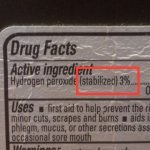
The catalyst is generally a metal, and once it is added, the peroxide breaks down very rapidly. As the peroxide breaks down, it releases a lot of oxygen. This results in a very showy outpouring of tiny soap bubbles (because the peroxide was mixed with soap). Hydrogen peroxide contains a lot of oxygen. The more concentrated the peroxide is, the more oxygen it releases. That’s why they are using 30% or 35% peroxide. (The hydrogen peroxide in brown bottles at the drugstore is usually 3%.)
Think of it this way: you start with peroxide and liquid soap. Then you add a catalyst. The peroxide reacts by breaking down into water and LOTS of oxygen. What’s left is water and liquid soap, which are turned into tiny bubbles by all that oxygen that is being released.
Generally this experiment is done in a small-mouthed bottle, so the stream of soapy bubbles is forced into a stream or tube of bubbles – which looks a bit like a FAT stream of toothpaste. Elephant toothpaste!
In some versions of the experiment, food coloring is used, which makes it look even more like toothpaste.
There are other variations:
- bottles with a smaller or larger opening will make the stream of “toothpaste” bubbles into a fatter or skinnier stream. A smaller opening will also make the stream of bubbles “fly out" faster – all that oxygen has to get out of a tiny opening, so it has to really move.
- the amount and concentration of peroxide and amount and type of the catalyst can make the reaction more or less dramatic. The more concentrated the hydrogen peroxide is, the more oxygen is released. The more and stronger the catalyst, the faster the oxygen is released.
- the experiment can also be done without soap. I’ve included a video with no soap, which has a different effect.
How to make Elephant Toothpaste
There are lots of sites with directions..... I’ve selected just a few, which have directions that I find clear and simple.
First here is a “kid friendly version”, using 3% hydrogen peroxide – which is easier to find, and safer to use. So this is a great version to use with kids. It uses active yeast at the catalyst, which also seems like an easy way to do this as a home experiment.
Here’s s similar set of directions, using active yeast, this time with 6% hydrogen peroxide. (You can get 6% hydrogen peroxide at some beauty supply stores, called 20 volume or V20.)
Okay, those are the safer kid-friendly recipes. The ones listed below use 30% hydrogen peroxide, which is more dangerous. The catalyst is potassium iodide. This experiment should be done using safety precautions.
This recipe uses 30% hydrogen peroxide, with potassium iodide solution as the catalyst.
Lets watch some more results!
These videos each have a bit different tone, but I have to say that overall, these people are all having a good time. This is really fun stuff!
Elephant toothpaste #4 – most dramatic! (Catalyst: not stated)
This is the most energetic stream of bubbles -- the foam actually hits the ceiling! (Notice that they kept the bottle stopped up for a very short time. This is dangerous. If you keep the bottle stopped up, it could explode. Please do NOT try this.) This video also does not show the set-up steps.
Elephant toothpaste demo video #5 – with colored stripes (Catalyst: not stated)
In this video they try to demonstrate (not too successfully) that the elephant toothpaste can actually be burned! Although it is wet, there is a lot of oxygen there….so it can be burned even though it is wet. This video also uses food coloring, so the “toothpaste” has the classic stripes that some toothpastes have. The food coloring is added on the sides of the tube. (That’s the first thing you see in the video – adding the food coloring.)
Hydrogen peroxide decomposition science experiment #6 – no soap (Catalyst: potassium iodide)
In this version of the science experiment, there is no soap – just hydrogen peroxide and a catalyst. The reaction is very fast and very dramatic. Very short video.
What do we learn from all this?
Well, we might learn a number of things, depending on what aspects of the experiment we are focusing on:
- a catalyst can make a reaction occur, and the reaction can be rapid and quite showy.
- potassium iodide, manganese dioxide and potassium sulfate are catalysts for hydrogen peroxide
- there’s a lot of oxygen hiding in hydrogen peroxide, enough to really make things move
- when soap has lots of oxygen released into it, it turns into soapy foam
Related ideas and a quiz
Here’s a science quiz about elephant toothpaste.
Here is a chart with the amount of oxygen in 3%, 6%, 9% and 12% peroxide, and discussion of the volume of oxygen in peroxide. This may be helpful if you are using the kid-friendly version of the experiment, and want to try slightly stronger or slightly weaker peroxide.
Information and a video showing a contact lens cleaning system, using hydrogen peroxide with platinum as a slow catalyst. (It takes 6 hours to be sure all the peroxide has broken down.) When the process starts, the hydrogen peroxide is useful for cleaning and sanitizing the lenses. At the end of the process, the peroxide has turned to water and oxygen. Since there is no peroxide left, the contacts are safe to use in eyes. This is different than making elephant toothpaste, in that the decomposition process is not used for “show”. But, this is still about using a catalyst (platinum) to break down hydrogen peroxide!
Hydrogen peroxide propulsion
Hydrogen peroxide is used to fuel rockets, planes, motorbikes, and all manner of moving contraptions. Can you see the connection between the elephant toothpaste experiment and using hydrogen peroxide as rocket fuel?
More experiments
Here’s another experiment with hydrogen peroxide, about catalase. (The part about hydrogen peroxide starts about ½ way down the page, under the heading “activity”.) This page has a link to an experiment using hydrogen peroxide to aid in seed germination and the rooting of plant cuttings. Mushroom and hydrogen peroxide science projects.
Return from Elephant Toothpaste to the home page for using hydtogen peroxide
Subscribe to Hydrogen Peroxide Explorers' Newsletter
Our newsletter will keep you up to date on new pages added, plus some Adventures you can try at home:
No worries! Your email will be used ONLY to send you newsletters.
Translate this page:
Recent Articles


-
Concentrations of hydrogen peroxide
Concentrations of hydrogen peroxide: what do %, strength, and concentration mean? Common concentrations, and what they are used for. Advantages and disadvantages of stronger concentrations. How to dil… -
Hydrogen Peroxide Prices
What's a ressonable price for peroxide? Is food grade more expensive? How to calculate price comparison e.g. 3% vs 12% -
Food Grade Hydrogen Peroxide and other types that are NOT food grade
 What's the deal with Food Grade Hydrogen Peroxide? What is it? Does it matter? Learn about stabilizers, grades, uses of food grade and other grades of HP!
 -
Commerical Peroxide Uses
There's such a variety of commerial hydrogen peroxide uses: bleaching foods, treating waste water, improving crop yields & more.
(Gallon):
(5 pounds):
For some links, I receive ad commissions, at no cost to you. More info here.
Site Search:
Subscribe to our newsletter (free):
Note: Products shown are sold by Amazon. This site does NOT sell hydrogen peroxide.
Do you like this site?
Copyright 2007 - 2019 using-hydrogen-peroxide.com

Please read our privacy policy and site disclaimers, terms of use, affiliate statement.
This site does not sell hydrogen peroxide. Information on this site should not be used as medical advice, and should not be used to diagnose or cure any disease. If you need medical advice, please see a licensed physician. 35% hydrogen peroxide is EXTREMELY concentrated, and can cause injury or death. 35% hydrogen peroxide must be handled with caution, care, and knowledge. NEVER use 35% hydrogen peroxide externally on people, other animals or plants. NEVER use 35% hydrogen peroxide internally for people or other animals. All applications of 35% hydrogen peroxide require a great amount of dilution.
Thanks for visiting.